From weighbridge ticket to audited number, in four stages.
This walkthrough follows real records through the running system: a lab certificate, a residue lot, a shipment. It tracks each one from the moment data arrives to the moment a certifier, an investor, or an offtaker reads a number on a dashboard. Every screen below is the actual product, not a mockup.
Data comes in three shapes today: a fourth is what breaks most systems
Field data, lab paperwork and system-to-system feeds don't arrive in one format. Rather than force everything through one narrow door, the platform recognizes each shape and validates it the same way regardless of which door it came through.
A field team's spreadsheet
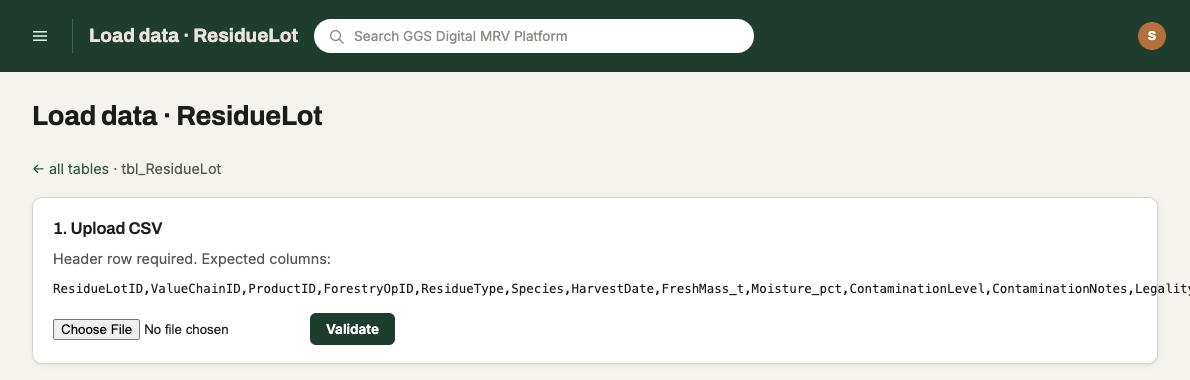
Harvest weights, lot numbers, and GPS-tagged movements, uploaded per table and validated row by row before anything commits.
A weighbridge or LIMS, talking directly
Authenticated system-to-system ingestion (POST /api/v1/tables/…), the same door a digital scale or a lab's own database can call.
An accredited lab's own export
A Certificate of Analysis arrives as one row per parameter tested: a different shape entirely, recognized on sight (see below).
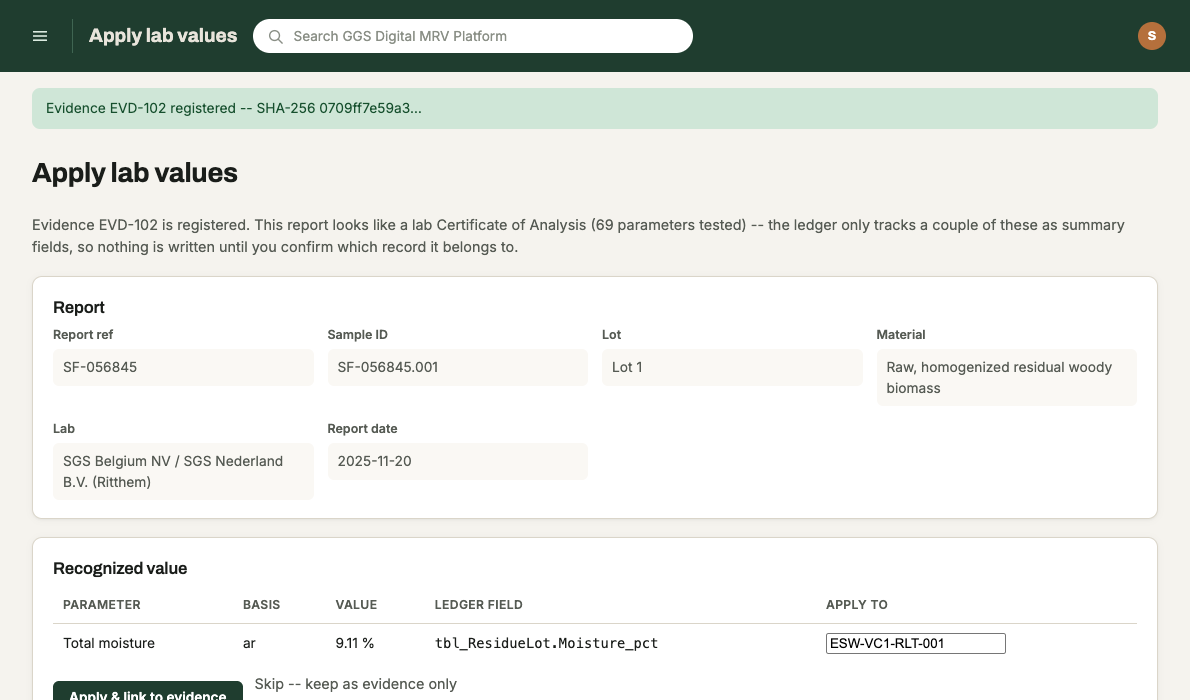
A real example of the third shape: an SGS Certificate of Analysis for a raw wood-residue sample, laid out as 69 rows, one per parameter and reporting basis (moisture, ash, volatile matter, calorific value, a full elemental breakdown). The ledger only tracks one of those as a number; the platform recognizes the shape, registers the whole document as evidence, and offers to pull the one field that matters:
Once fully implemented
The intake doors above are built and running. The roadmap below adds real sources already named in the platform's own integration plan, not hypothetical ones:
Live today
Next to connect
One validator, not three: a rule can't be true on one door and false on another
Whichever door a record arrives through, it passes the same checks before it becomes a ledger row: does the ID match this entity's format, is every value the right type, is a computed field being supplied as if it were an input.
- ID format is enforced, not suggested. A pellet batch is
ESW-VC1-PLT-###; a shipment isESW-VC1-SHP-###. A malformed ID is rejected on sight, not stored and flagged later. - Computed fields can't be typed. Dry mass, GHG intensity, spec-pass/fail: all derived server-side on every request. Supplying one as input is a rejection, not a silent overwrite.
- Type and range checks run before commit. A date that isn't a date, a number that isn't a number, an enum value outside its allowed set: caught at the door, with the specific reason shown.
Every hop back to the source, or the gap is shown, not hidden
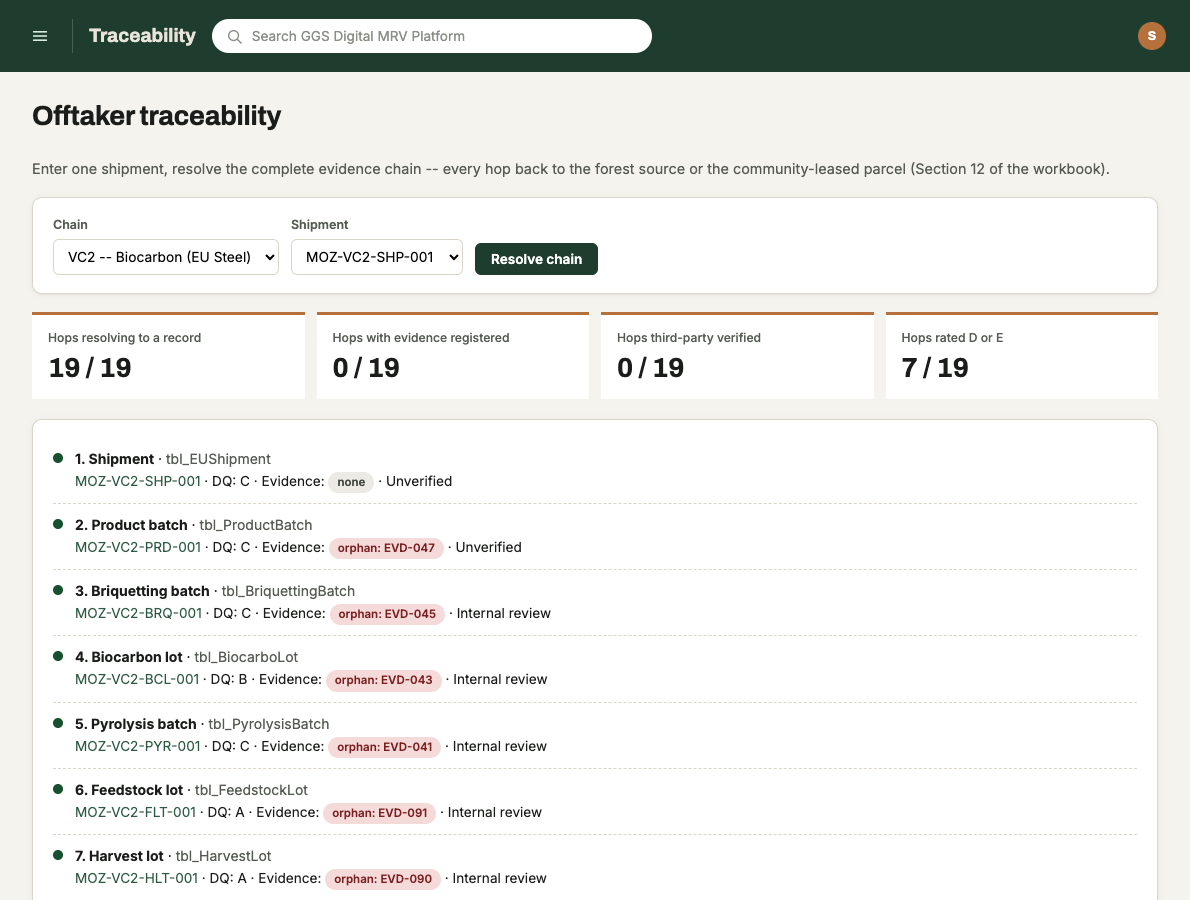
A shipment resolves backward through every processing step to its physical origin: a forest parcel, a community-leased field. Where a hop is missing evidence, that's shown as a gap, not smoothed over.
Red-flag engine
Threshold and consistency checks re-run on every request against live data. Not a periodic batch job.
Cross-chain firewall
Structural guarantees, chiefly: nothing from VC1 and VC2 ever mixes in a single record.
Evidence register
Every supporting document is hashed and linked; an orphaned or missing reference surfaces automatically, not by audit.
The same ledger, five different views, computed live and never cached
An administrator, a certifier, an investor and an offtaker are reading the same underlying data, but each sees only what their role is entitled to, computed fresh on the request that renders it.
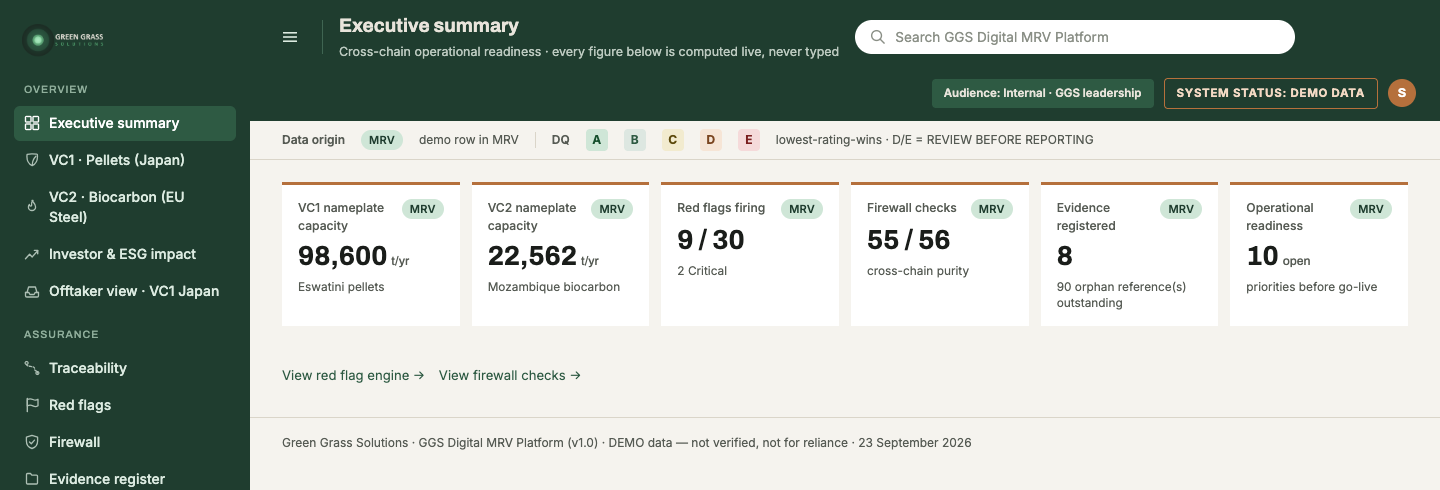
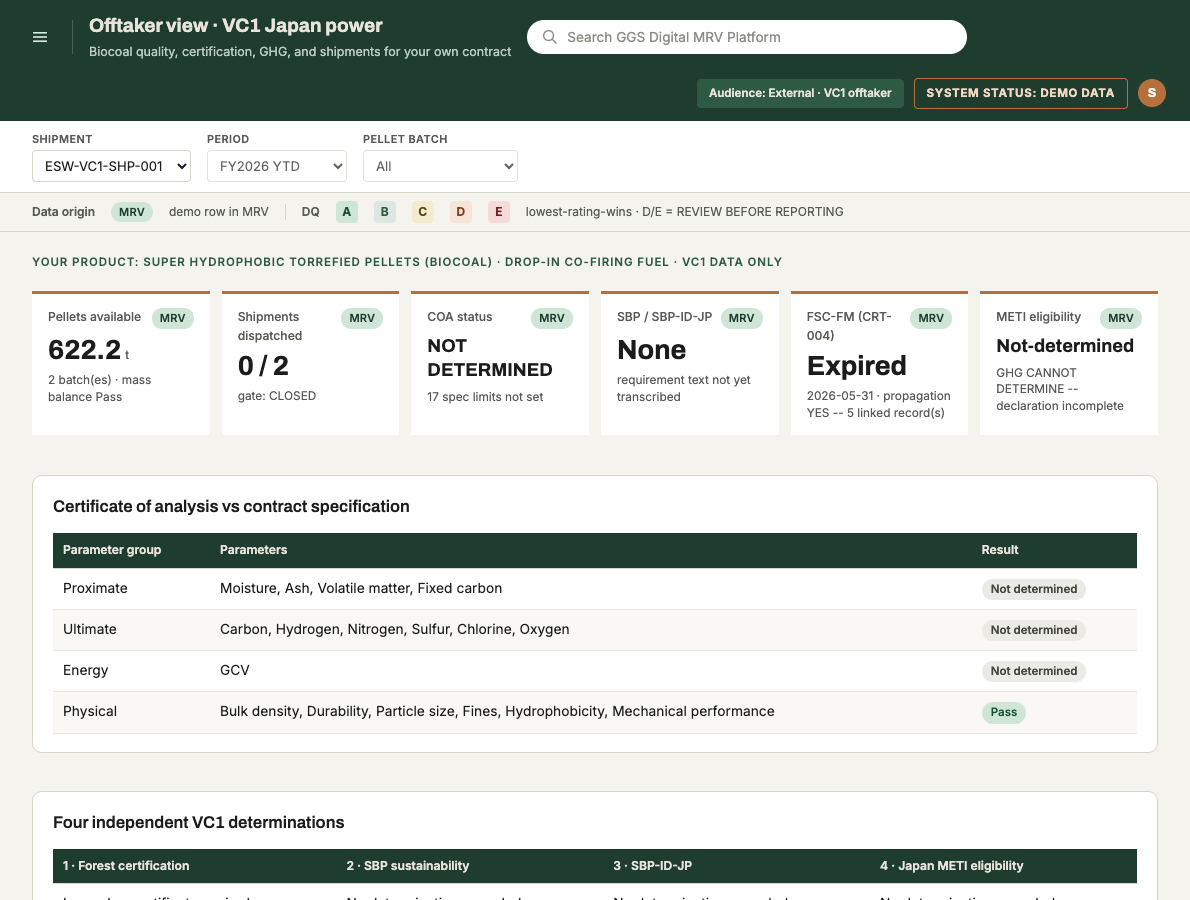
The reverse is just as deliberate: when a real value doesn't exist yet, the platform reads "Not determined," rated E, low confidence. Never a placeholder dressed up as a result. That discipline is the product.
What changes at full rollout
The four stages above don't change shape. Phase 2 (seven sub-phases, October 2026 to August 2027) adds real intake doors for weighbridge and lab systems and satellite land monitoring, decision engines for REDIII, FIT/FIP/METI, and SBP eligibility, an automated carbon-claim gate, and a GHG estimator. The same validator and assurance engine keep running underneath all of it, and the same five dashboards keep reading whatever the ledger actually contains. Phase 2 closes with a live pilot running both value chains end to end.
Nothing shown in this walkthrough is a mockup. It's the same application a signed-in user opens today.